
Cash, Bit and card in a small business: how to accept and how to record
How much cash you may accept, Bit fees in 2026, what card clearing costs a small business and how to record a Bit payment on a receipt. A practical guide.
In a small business, most money arrives in three ways: cash, Bit (or PayBox) and a credit card. Cash costs no fee, but the law limits it above ₪6,000. Bit is free up to ₪25,000 a year, and above that a fee applies. Cards cost small businesses about 1% of each transaction on average. And for every payment, by any of the three, you issue a receipt that states how it was paid.
Here is what each method costs, what is allowed, and how to record each one so your accountant doesn't have to ask.
In short
- Cash: up to ₪6,000 per transaction there is no limit. Above ₪6,000 you may accept in cash only 10% of the price or ₪6,000, whichever is lower.
- Bit: no fee up to ₪25,000 a year received from individuals. Above that, 0.8% on the difference (from May 1, 2026). You can receive up to ₪100,000 a year in Bit.
- Card: small businesses paid an average of about 1.07% of transaction value in Q2 2026. You may not demand a minimum amount for paying by card.
- Every payment gets a separate receipt. For Bit, transfers and cheques, the payer's name goes on the receipt too.
- At the end of each day, compare: drawer against POS, terminal against POS, app against receipts.
Quick comparison
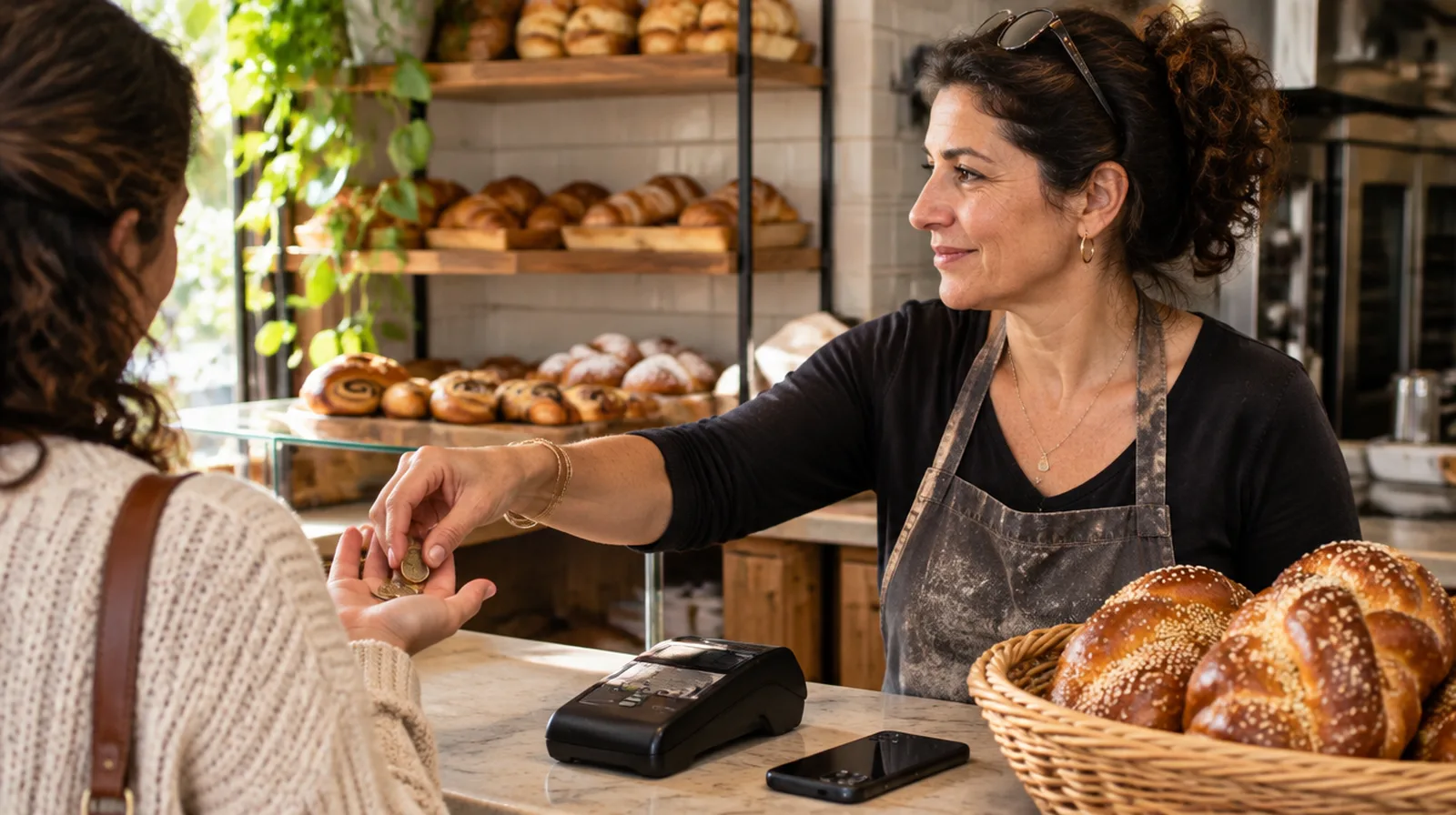
- Cash — What it costs you: No fee; Main limit: Above ₪6,000 per transaction: up to 10% in cash or ₪6,000, whichever is lower; What goes on the receipt: Amount, "cash"
- Bit — What it costs you: No fee up to ₪25,000 a year, then 0.8% on the difference; Main limit: Up to ₪100,000 a year; What goes on the receipt: Payer's name, "Bit", reference
- PayBox — What it costs you: No fee at present, under its terms of use; Main limit: Per the app's terms; What goes on the receipt: Payer's name, "PayBox", reference
- Credit card — What it costs you: A fee set by your agreement (small-business average about 1.07%) plus the terminal cost; Main limit: You may not demand a minimum; What goes on the receipt: "Card", last digits or approval number
- Cheque — What it costs you: No fee; Main limit: Only a cheque that names the payee; What goes on the receipt: Cheque number, bank, branch, due date
Cash: no fee, with a ceiling
What the law says. Under the Law to Reduce the Use of Cash, a dealer may accept cash without limit in a transaction of up to ₪6,000. In a larger transaction, only 10% of the price or ₪6,000, whichever is lower, may be accepted in cash. The rest comes by card, transfer or cheque. These amounts have been in force since August 1, 2022. The ceiling applies even when the customer is a private person. The ₪15,000 you may have heard of is for a transaction between two private individuals, not for buying from a business.
Note the jump above ₪6,000:
- A sale of ₪5,800: you can accept all of it in cash.
- A sale of ₪6,500: you may accept only ₪650 (10%) in cash.
- A sale of ₪80,000: you may accept ₪6,000 in cash (the ceiling is lower than 10%).
With a tourist, the ceiling is higher: up to ₪40,000 without limit.
What a mistake costs. The Tax Authority (רשות המסים) imposes a financial penalty on the dealer based on the amount received above what is allowed: 15% up to ₪25,000, 20% up to ₪50,000 and 30% above that. An example: a ₪8,000 sale paid entirely in cash. You could have accepted ₪800, so ₪7,200 is over the limit. The penalty: 15% of ₪7,200, which is ₪1,080. Repeating the same violation brings an additional penalty, and a private customer is also likely to be fined.
Cheques. A dealer accepts only a cheque that names the payee, in any amount. An "open" cheque is not allowed. On an endorsed cheque, the name and ID number of whoever endorsed it and of whoever received it must appear.
Cash at the counter, day to day:
- Open the day with a fixed small float (for example ₪200 in change), and record it.
- Close the day with a count. Compare the cash in the drawer to the cash in the POS, minus the float.
- Deposit at the bank on a fixed schedule. That way the money in the account matches the sales.
- Don't mix in personal money. A coffee paid from the drawer shows up as a count difference.
Bit and PayBox: free, up to a point
Bit and PayBox are apps for sending money between people, and many small businesses take payment through them. What to know:
- Bit fee. From May 1, 2026, Bit charges 0.8% on money received from individuals above ₪25,000 in a calendar year. Up to ₪25,000 there is no fee.
- Bit ceiling. You can receive up to ₪100,000 a calendar year from individuals in Bit.
- PayBox. Under its terms of use (in force from November 1, 2026), PayBox doesn't currently charge fees, but reserves the right to. Check the latest terms in the app.
- It is business income. Money for a sale is income, even under ₪25,000. Bit's threshold is the app's, not the Tax Authority's.
What does it cost in practice? A stall that receives ₪60,000 a year in Bit pays 0.8% on ₪35,000, which is ₪280. The same turnover by card, at the small-business average fee (1.07%), costs about ₪642, before the terminal cost.
Watch the ceiling. The osek patur (עוסק פטור, VAT-exempt dealer) ceiling in 2026 is ₪122,833 turnover a year, and the Bit receiving limit is ₪100,000. A business nearing the osek patur ceiling can't run all its sales through Bit. How to track the ceiling is in our guide to the 2026 osek patur ceiling.
How to record a Bit or PayBox payment
- Issue the receipt the same day. Under the bookkeeping directives, a payment that arrived by transfer into the account is recorded on the day you learned of it. With Bit that is usually right away.
- A separate receipt for each payment. Even when the same customer paid twice in one week.
- The payer's name on the receipt. The directives waive the payer's name only for a retail cash sale. For Bit, PayBox and bank transfers, the customer's name goes on the receipt, and their address too, unless you already have it.
- Payment method and an identifying detail. Write "Bit" or "PayBox", and add a detail that lets you find the transfer: the app's reference number, or the last four digits of the payer's phone. The Law to Reduce the Use of Cash requires you to record the payment method in a way that identifies it.
- A weekly check. Open the transfer history in the app and compare it to your receipts. Every transfer without a receipt is a missing receipt.
Make sure the money goes into a bank account your accountant knows as part of the business. What exactly a receipt must contain is in our guide to the receipt obligation.
Credit card: what it costs and what to ask
What small businesses pay. According to Banking Supervision data, in Q2 2026 small businesses (card clearing turnover of up to half a million shekels a quarter) paid fees of about 1.07% of transaction value. Large businesses paid about 0.61%. So on every ₪100 by card, a small business pays about ₪1.07 on average. That is an average. Your agreement can be higher or lower.
You may not demand a minimum. Since April 2025, a dealer who allows card payment may not make card payment conditional on a minimum purchase amount (Amendment 72 to the Consumer Protection Law). A sign saying "cards from ₪30" is a violation.
Before you sign for a terminal, ask:
- What is the fee percentage, and does it differ between a credit card and a debit card?
- What does the terminal itself cost: purchase, monthly rental or a fixed monthly fee?
- When does the money reach the account, and what does it cost to get it sooner?
- Is there a commitment period? What does it cost to leave?
- Does the terminal work on its own mobile network, or does it need Wi-Fi?
How to record. When the terminal isn't connected to the POS, you do two things in order: charge the card on the terminal, and record a card sale in the POS for the same amount. At the end of the day, compare the card total in the POS with the terminal report. The directives require you to keep all settlement documents with the card company as part of the books, so keep the monthly reports too.
Refunds: give back the same way
A customer returned an item? The simple rule: refund through the same method they paid with.
- Paid in cash: refund cash from the drawer, and remember the evening count will be lower accordingly.
- Paid by card: cancel or credit through the terminal, not in cash. That way the terminal report and the POS stay in step.
- Paid by Bit or PayBox: send it back in the same app, and keep the reference.
In every case, you don't delete or alter the original receipt. Under the bookkeeping directives, a cancelled document is kept, and in a computerized system you correct only with an additional document, meaning a credit note that refers to the receipt. Your accountant needs to see both the sale and the refund.
End of day: three comparisons
- Cash: the drawer count against the cash in the POS.
- Card: the terminal report against the card total in the POS.
- Bit and PayBox: the transfers in the app against the receipts you issued.
A gap found that evening takes minutes to track down. A gap found at the end of the month takes a whole evening. What to send your accountant and how often is in our guide to the Z report for your accountant.
With us, in Kupahinam: you record cash, cheque and cards that went through your own terminal. Without internet you keep selling for cash and cheque. A Z report (דוח Z) goes by email to your accountant, daily, weekly or monthly.
A free POS that records every payment Kupahinam: 300 receipts a month, unlimited products, cash, cheque and cards from your own terminal, offline mode and a Z report by email to your accountant. Runs in the browser, no credit card. Open your free POS
What else you need from day one, beyond payments, is in the complete guide to a free POS for an osek patur and osek zair.
This information is based on publicly available data (Tax Authority, Bank of Israel, the statute book and the terms of use of Bit and PayBox), as of November 2026. It is general and is not tax or financial advice. Fees and terms change, so before deciding, check your agreement and consult your accountant.
FAQ
How much cash may a business accept from a customer?
In a transaction of up to ₪6,000, as much as you like. Above ₪6,000, only 10% of the price or ₪6,000, whichever is lower. The rest is taken by another method. With a tourist the ceiling is ₪40,000.
Do I need to issue a receipt for a Bit payment?
Yes. Bit is a payment like any other. Issue a separate receipt on the day you see the transfer, with the payer's name, amount, "Bit" and a detail that identifies the transfer.
How much does Bit charge a small business in 2026?
From May 1, 2026, 0.8% on money received from individuals above ₪25,000 in a calendar year. Up to ₪25,000 there is no fee. The annual receiving limit in Bit is ₪100,000.
Can I put up a sign saying "cards over ₪20 only"?
No. Since Amendment 72 to the Consumer Protection Law (April 2025), a business that accepts cards may not demand a minimum purchase amount for card payment.
Which is better for a small business: Bit or card?
On cost, Bit is cheaper up to ₪25,000 a year and usually above that too. But not every customer uses Bit, and there is a ceiling of ₪100,000 a year. Most businesses accept both, and check every evening that both were recorded.
Written with AI help and fact-checked
Start free
One branch. One user. 300 receipts a month. ₪0 for the software.
Offline mode — keep selling when the internet drops
Start at ₪0 and grow with us whenever you’re ready: Register ₪79 or Smart POS ₪119 per branch per month + VAT — same account, all your data.
This content is published on a site run by KupaLi. General professional information does not replace advice suited to your business.